






|
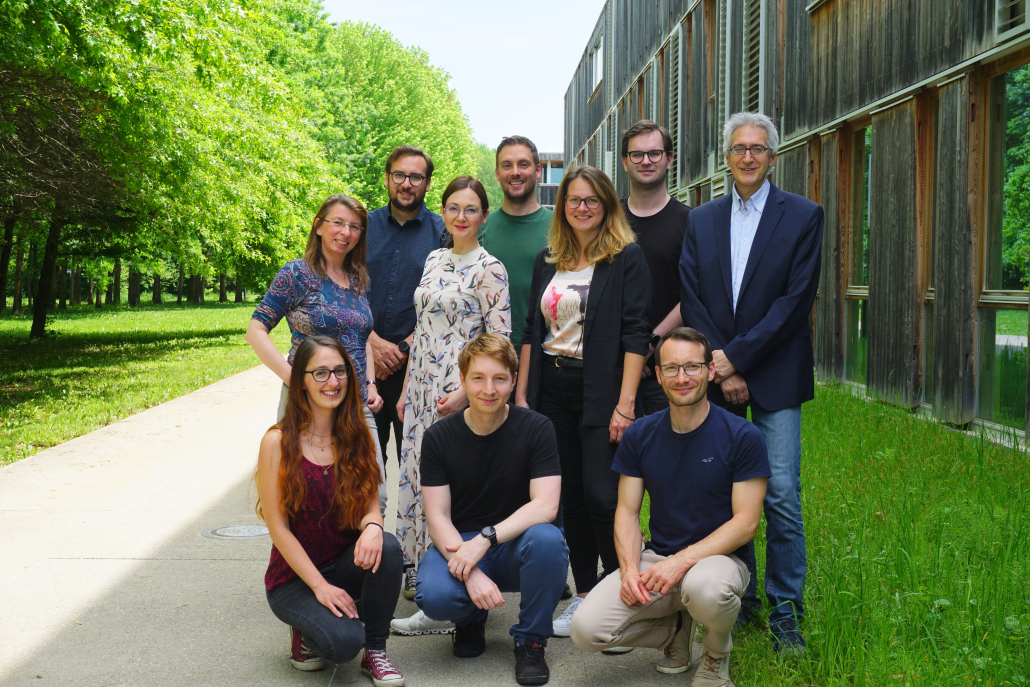
| The Klagenfurt Informatics Didactics (KID) Team |
As demonstrated by the projects AMEISE and PlaNet-ET, ISYS has a strong history in academic teaching. Its members were also instrumental in establishing informatics as an area for the academic formation of informatics teachers for secondary schools.
With informatics becoming a topic in teachers formation, the research group on informatics didactics, (KID – “Klagenfurter Informatik-Didaktik”) has been formed. It focuses on didactical issues for secondary school teachers, both in general academic gymnasia as well as in vocational schools.
With ISSEP 2005, KID started an international conference series on Informatics in Secondary Schools: Evolution and Perspective. It had its successor event with ISSEP 2006, where KID members were still instrumental. Currently, researchers and practitioners are invited to ISSEP ’08.
A little more than 20 years ago, Informatics has been introduced as compulsory subject in secondary schools in Austria. Since then, the discipline has witnessed dramatic changes in both technology and applications. These changes have to be addressed by teaching pupils, but pupils (and their teachers) must not be overwhelmed by waves of constant change.
Informatics didactics has thus a twofold mission:
In the teacher’s formation curriculum, students have to combine two school-subjects with a common branch in pedagogy. School-informatics (“Informatik und Informatik-Management”) can be combined with any other school topics. Many students choose a combination with Mathematics or (due to historical reasons at this university) with Geography. But combinations with school-disciplines of philology are as welcome. Even combinations with subjects that are not offered at this university (natural science disciplines or Sport) are feasible.
Our research is of empirical as well as of conceptual nature. The ISSEP conference series, established by KID, provides us with contacts on a wide international level and allows synchronization of work across national boarders. On the local levels, experiments conducted by diploma students can, if carefully conducted, still contribute to clarify the relative merit of competing didactical approaches.